Madrona Nutrition and Fitness: Recipe and Nutrition Guide

Madrona Nutrition and Fitness:
Guide to Wellness through Holistic Diet
and Lifestyle

Rachel Fiske
Certified Holistic Nutrition Consultant,
Certified Personal Trainer

Monday, December 13, 2010

Baked Coconut Chicken Recipe

This was described last night by more than one person as the best chicken they had ever had...and I am inclined to agree. Its full of healthy fats like coconut, organic butter from grass fed cows, and ghee (see previous blog on fats). Hopefully by now we have embraced the importance of good fats in our diet and are eating plenty of protein which is so essential to our overall function (at least 20 grams per meal, especially at breakfast!). This recipe was adapted from Eat Fat Lose Fat by Dr. Mary Enig and Sally Fallon. They call for 1 cup of sourdough breadcrumbs, but I substituted flax and almond meal. Enjoy!

1 Tablespoon flax seeds
1/4 cup almond meal
1 tablespoon curry powder
1 teaspoon sea salt
1 cup shredded unsweetened dried coconut 
1/2 cup fresh orange juice
1 egg
6 chicken thighs (or whatever chicken you have)
1/2 cup of either butter, ghee, or coconut oil (I used a blend of all three)

Preheat oven to 350 F. Mix together flax and almond meal, curry powder, salt, and coconut on a large plate. Pour orange juice into a small bowl with one beaten egg. Dip the chicken into the juice/egg mixture, and then in the "breading" mix. Place prepared thighs into a buttered pyrex pan. Melt butter/coconut oil/ghee together in a small saucepan (or in the oven) and pour over chicken. Bake for at least an hour, or until chicken is cooked through.


Monday, December 6, 2010

Recognizing and Managing Adrenal Fatigue


Hey everyone! My current homework assignment for my Holistic Nutrition Consultant program (year and certification #2), is surrounding adrenal health, and I thought I'd share! Its interesting, applicable stuff...

Today's fast-paced, technologically and consumer driven society with its many demands and pressures, can (and does) easily lead to chronic stress in our lives. This stress can strongly influence our mental and emotional state, our relationships, and (what I will be focusing on) our physical well-being. Common symptoms include overall exhaustion, a feeling of being emotionally void, unable to respond to stressful situations without feeling totally wiped out, dark circles under your eyes, very emotional or "on edge," weight gain around your waist, strong carbohydrate and sugar cravings, a slowed metabolism, insomnia, irritability, and more (LaValle, Cracking the Metabolic Code, p. 75). These symptoms occur because this chronic stress may have led to fatigue of our adrenal glands, which are the glands that control our reactions to stress, and interact with/effect many hormones in our body (including stress hormones such as cortisol). According to LaValle, PhD in his book Cracking the Metabolic Code, "the adrenal glands regulate stress, blood pressure, and blood mineral content through the secretion of various hormones" (75). Below, I have detailed three nutrients essential for managing adrenal stress/fatigue, including one macronutrient, micronutrient, and phytonutrient. It is important to note that if you are experiencing adrenal fatigue, your adrenals may be in one of many stages. Depending on the extent of the stress placed on them, If dietary changes are not helping, it may be necessary to work with a naturopath or holistic nutrition professional to seek further guidance in nourishing and supporting adrenal health.

MACRONUTRIENT:  PROTEIN

     While focusing on eating all quality macronutrients is very important (fat, protein, carbohydrates), protein is the building block of our cells. We need quality protein to keep our systems working properly and efficiently, and not putting undue stress on our adrenals. It is essential for building and rebuilding our cells, muscles, bones, ligaments, tendons, hair, eyes, nails, and other tissues. When we we do not eat sufficient protein (as many people do not), it puts stress on our bodies, and stress is exactly what we need to avoid when addressing adrenal fatigue. Some good sources of protein include: grass-fed organic beef and lamb, poultry, liver, eggs, whole dairy products (yogurt, raw cheese, whole milk) and (in some cases) quality protein powders. Next to animal products, legumes and whole grains have the next highest level of protein. 

MICRONUTRIENTS: CALCIUM AND MAGNESIUM

     According to LaValle, 75% of people in the US are deficient in magnesium. Nori Hudson of Radiant Vitality repeatedly states, "when in doubt....magnesium!" Calcium needs to always be in balance with magnesium, and both together are anti-stress minerals. Magnesium slows the release of epinephrine and norepinephrine from the adrenal medulla, and is therefore critical in balancing the sympathetic nervous system. It also aids in decreasing insulin resistance and stabilizing blood sugar, something crucial for adrenal health (LaValle, 87). Signs of magnesium deficiency include leg cramps, restlessness, insomnia, nervousness, constipation, anxiety, muscle weakness, and more.

PHYTONUTRIENT: LICORICE

     Licorice is an amazing herb for adrenal support. It directly acts as an adaptogen for our cortisol levels, either rising or suppressing it as needed. Along with this, it is a wonderful anti-inflammatory agent and digestive aid. Dosage will depend on body weight, so work with a nutrition professional to determine your appropriate amount. 

Here are some other suggestions of ways to change your overall diet for adrenal health. Remember, there are so many factors that go into supporting the adrenals, and these are just a few to consider! Feel free to contact me with further questions!

*Strive for at least 20 grams of protein at each meal, if not more.   

*Try sautéing with either coconut oil, ghee, whole milk organic butter

*When using milk or yogurt, go for whole, organic. The nutrient value of whole dairy is much greater, and it will keep you satisfied for longer.

*When buying meat, it is so important to buy organic! The majority of the toxins we take into our bodies are through animal products. If you cannot buy organic, go for leaner cuts, as toxins are stored in fat.

*Incorporate 1-2 T ground flax seeds daily

*Incorporate 1000-5000 IU’s of cod liver oil daily

*Try sipping a cup or so of home-made chicken or mineral (veggie) broth. Add 1-2 tbsp miso paste as well for a delicious taste. This is a fantastic way to easily absorb minerals throughout the day and is very soothing/anti-inflammatory to the body and adrenals.

*Incorporate sauerkraut into your daily diet! Fermented foods such as this are great as they add probiotics and aid with digestion.

*Each day, try to include herbal teas and at least 60 oz of purified water (add lemon too for vitamin C!)

*Its also a great idea to include some natural chelators to your diet, which bind with toxins and remove them from the body. These include cilantro, chlorella, garlic, and milk thistle.

*It is also essential to plan your meals and snacks according to blood sugar regulation, in other words, don't let yourself get too hungry! Another post soon to come on this subject.

*Consider going gluten free. According to Marcelle Pick, NP, OB GYN, most women who have adrenal fatigue are also sensitive to gluten.

AND DONT FORGET THE IMPORTANCE OF DE-STRESSING, IF NOTHING MORE THAN TAKING TEN MINUTES PER DAY FOR DEEP BELLY BREATHING!


Sunday, December 5, 2010

Amazing Coconut Macadamia Yam Mash

Hello all! Well this recipe is a little late considering Thanksgiving has come and gone (along with our tighter-fitting clothes...we'll simply retire you until Spring), but I made this dish for the occasion and it would be great for Christmas, Hanukkah, or any night Monday-Sunday. Its absolutely delicious, and a nice change from 1) standard mashed potato dish which, if you have inflammation and particularly joint pain, you should stay away from (as well as all other nightshade vegetables), or 2) typical sweet potato dish with marshmallows and whatever other crap is generally included. 


As always, a brief lesson the endless benefits of yams. Yams are a great source of potassium, which is crucial for controlling blood pressure. Also, they are full of vitamin B6, which is linked to decreased risk of heart attack and stroke. Yams are additionally good for blood sugar regulation, as they are a complex carbohydrate which release sugar into the blood at a slow and steady pace. This mixed with its high fiber content make us satiated, and therefore, help with weight control. Yams are also very high in vitamin C (27% of our daily value in one cup of cubed yam), B vitamins, magnesium, calcium, and phosphorus. 


Also included in this recipe are macadamia nuts, which are chalked full of of antioxidants, vitamins, minerals, and heart healthy monounsaturated fats. The recipe also includes coconut, which I previously wrote an entire blog on because its just that good...but includes among other things incredibly healthy short and medium chain fatty acids (that are great to cook with because they don't go rancid at high temperatures), provide us with energy that is not stored as fat (it can actually help us lose weight), and is rich in lauric acid which protects and boosts the immune system.


So now that we're all excited...try out this recipe!


Coconut Macadamia Nut Sweet Potato Mash

Source: Heidi Swanson (6 servings)

2 ½ lbs. orange-fleshed sweet potatoes
⅓ cup coconut milk
1 tablespoon fresh ginger, grated
1 tablespoon maple syrup
½ teaspoon fine-grain sea salt
⅓ cup raw, unsweetened grated coconut
2 tablespoons melted butter or coconut oil
⅓ cup toasted macadamia nuts, chopped
Preheat your oven to 350F degrees, a rack in the upper third. Butter or oil 6 ramekins or a single medium-sized casserole dish.

Wrap each sweet potato in foil, pierce numerous times with the tines of a fork and place in the oven for somewhere between an hour and an hour and a half, until each is baked through. Times vary greatly depending on the size of your sweet potatoes - in the end you should be able to cut through the center flesh as if it were soft butter.

Remove the potatoes from the oven, let them cool for a few minutes, and cut each sweet potato in half. Scrape the flesh into a medium mixing bowl. You should have about three cups of sweet potatoes.

In a large bowl mash the sweet potatoes with the coconut milk. If my sweet potatoes are on the fibrous side, l take a hand blender to them for a minute or so (alternately you could use a food processor). Stir in the ginger, maple syrup and salt. Let it sit for a few minutes, stir again and taste - adjust the seasoning if you need to - this is your chance to get the right amount of salt and ginger in the sweet potatoes before they go in the oven.

Spoon the sweet potato mixture into individual baking dishes (or single larger baking dish), sprinkle with coconut, drizzle with olive oil and bake uncovered until warm and the coconut golden roughly 30 - 40 minutes.

Remove and sprinkle with the toasted macadamia nuts
.

Wednesday, November 24, 2010

So you want to do a cleanse, huh? But do you know why?

In recent years, we have become a society who just loves to do cleanses, detoxes, etc. And why not? We love quick fixes (or thinking we are getting a quick fix). I am by no means innocent of this, having jumped head first onto the cleanse band-wagon many-o-time. Now, I am not saying that cleansing and detoxing our bodies is a bad thing...not in the least! In our modern day lifestyle, we are absolutely exposed to a laundry list of toxins on a daily basis that affect our liver and our overall health in both the short and long term. HOWEVER....putting sudden strain on our liver and other detoxing systems to all of a sudden deal with and purge all of these toxins is not only ineffective, but can be quite dangerous, as well. So lets look at why these extreme detox regimens can be hazardous, and alternatively some safe, healthy, and effective ways to cleanse our bodies and achieve optimal health.


What does it really mean to cleanse our bodies/organs??


Good question Rachel! Thanks guys. So when we are talking about detoxing and/or cleansing, what that typically means is a diet that supports liver and bowel cleansing. The liver is the largest organ in the body, and its primary function is to detoxify, and also plays key roles in body metabolism (hint: if you simply can't lose weight, liver dysfunction may be to blame!). The liver filters the blood coming in from the GI tract...up to 2 quarts per minute! If functioning optimally, it will detoxify 99% of bacterial toxins on its first go (Bauman, 2010). The liver also creates and excretes bile, which is a carrier for many toxic compounds and eventually eliminated in our stool. The liver is detoxifying all KINDS of nasty toxins, including: Environmental toxins such as pesticides/herbicides, heavy metals (mercury, arsenic, lead, etc), drugs/pharmaceuticals, used hormones and neurotransmitters, food additives and altered (trans) fats, and more. A toxin is any substance that undermines our overall state of wellness, and is irritating/harmful to the body. Aside from the liver, we also detox through our respiratory, urinary, lymphatic, and gastrointestinal systems (of which the liver is a part of). So...when we talk about cleansing, we should be talking about healthy, effective, and SAFE ways to support these systems through food and perhaps some herbal supplements. But as is always my motto....start with food!!!


How do I know if I need to detox??


A gentle cleansing diet to support the liver and other detoxifying organs is rarely a bad idea (unless we are suffering from disease/health conditions, in which case consultation with a medical and/or nutritional professional is in order). Common signs of liver overload can include: fatigue, headaches, constipation and/or light/tan colored stool (impaired bile production), rashes, hives, acne (your body trying to detox), bloating, increased sensitivity to chemicals (for example, you walk into a department store and instantly get a headache from the perfumes), and more. These are signs that your liver is not functioning as it should be, and some simple dietary changes are in order, before you ever consider anything more drastic (fasting, liquid diets, etc). If you jump right into an extreme diet like this without having proper liver function first, you will make yourself ill! Too much, too fast. Again, start with food, and lets take a look at how to do this...

What does a cleansing diet look like??


Now, with all of this being said, gently cleansing/detoxing our bodies and organs can be incredibly benefit. Here are some of the reasons why:


• Improved Energy, Vitality, Productivity, and Mental Clarity
• Reduced Food Cravings
• Improved Digestion
• A Jump-Start to Successful Weight Loss
• Reduced Allergic Symptoms
• Lower Cholesterol and Blood Pressure 


Cleansing the body should start with ridding the diet of certain foods, like trans fats, processed/refined sugar and flour (this means pastries, cookies, candies, etc), coffee, alcohol, and nicotine. You may also want to eliminate gluten and dairy for a bit. In place of these foods, add whole, organic foods such as fresh, seasonal fruits and vegetables, whole (preferably non-glutenous) grains, and herbal teas. Include lots of dark, leafy greens (kale, chard, spinach, dandelion and mustard greens, bok choy, etc), and also include seaweed and algaes (dulse, wakame, spirulina, chlorella are a few examples). These will provide the body with important trace minerals (minerals you do not get anywhere else), and also work as natural chelating agents (particularly chlorella, meaning it binds to toxins, particularly heavy metals, and draws it out of the body). Garlic and cilantro do this as well!


So, in summary....I am not necessarily against more extreme detox/cleansing regimens, which may comprise liquid or juice fasts (preferably with vegetable juice), or other types of plans. I have done them myself. However, if our liver and other cleansing systems/organs are not in the proper shape to handle something like this (and most of us aren't given the daily exposures of our modern society), we NEED TO BEGIN WITH FOODS! If you are interested in further cleansing diets/plans, please do so safely and seek guidance from a holistic nutrition professional, like, well....me! :)


Hows THAT for something to think about pre-holiday season???


Friday, November 19, 2010

Delicious Kale Salad!

Just wanted to quickly post this amazing kale salad recipe that is so simple, tasty, and good for you! I have served this dish to people wary of kale and they've loved it, and fellow kale enthusiasts find themselves making it weekly. The following recipe is the whole sha-bang, if you will (and you will)...but if you're pressed for time simply throw the three main dressing ingredients together and massage it into some kale. And there ya go, you've got yourself a salad!!


Let me give a brief overview of the myriad of kale's health benefits. It is incredibly nutrient dense, first of all being full of powerful anti-oxidants that protect our cells from free radicals (like those found in rancid oils, like canola and vegetable oils). Kale is one of the best sources of Vitamin K, as well, which is crucial for anti-blood clotting properties and absorption of calcium (among other things). Furthermore, kale has been proven to act as an anti-cancer agent , provides cardiovascular support, and is very anti-inflammatory due to its amounts of omega 3 essential fatty acids. According to whfoods.com, It only takes 100 calories of kale to provide us with 25-35% of the National Academy of Sciences' public health recommendation for the most basic omega-3 fatty acid (alpha-linolenic acid, or ALA). We suspect that this amount will be plenty to show direct anti-inflammatory benefits from regular kale intake." So...eat up!!


1/3 cup tamari soy sauce (tamari is better than regular soy 
because its fermented! Yay probiotics!)
1/3 cup lemon juice
1/3 cup flax seed or extra virgin olive oil
1/2 medium- seized red onion
1/4 cup sunflower seeds
1/4 cup pumpkin seeds
1/4 cup sesame seeds
1 lb. fresh kale
1/2 cup alfalfa sprouts
1/2 cup sunflower sprouts
1 avocado, cut into 1/2 inch cubes (optional)
1 cup thinly sliced shiitake or crimini mushrooms (optional)

Combine the Bragg or soy sauce and lemon juice in a blender or whisk in a bowl.  Slowly dribble in the oil as the blender turns or as you whisk vigorously.  Slice the onion into thin half-moons and marinate in the dressing as you prepare the rest of the salad.

Toast the seeds in a heavy bottomed pan over medium heat until seeds are just golden and fragrant.  Toast each seed type separately as their size requires varying roasting times.  Cool to room temperature.

De-stem the kale.  Stack the kale leaves and slice into 1/4 inch ribbons.  This is the most important step so make sure that you take your time.  The success of this recipe lies in cutting the kale into small ribbons and in completely massaging the kale with the dressing.

Toss the seeds, sprouts, and kale together in the marinated onions and as much dressing as necessary to lightly but completely dress the kale.  Massage the dressing into the kale with your hands.  Add the avocado and mushrooms if using and toss again with your hands.

Serves 4-6!

Recipe courtesy of Esalen Retreat Center in Big Sur, CA

Tuesday, November 9, 2010

Chemicals in Fast Food Packaging Show Serious Health Risks

I just read this article on one of my favorite alternative news website, commondreams.org. As I'm rushing around this morning trying to get a million things done, I don't have as much time to comment on it as I'd like, but the article speaks pretty clearly for itself! 


Quick rundown: A recent study published by the US National Institute of Environmental Health Sciences focused on perfluoroalkyls (PAPs), which are chemicals used in (among other things) fast food wrappers and microwave popcorn bags as an anti-grease and oil agent. It has been found that these chemicals seep into the food they are packaging, and then we eat them! These chemicals have been linked (in this particular study and others) to significant changes on sex hormones and cholesterol levels, as well as early death and delayed development in rats. Keep in mind, as is the case with so many chemicals used on our food today, many of the long term side effects cannot be "proven" yet, because they are so new to the market and largely will be multi-generational, which is why we see these types of effects in studies done on rats (poor little guys).


So, aside from the ENDLESS list of other reasons fast food is detrimental to our health, here's yet another one to add to the list.


Chemicals in Fast Food Wrappers Show Up in Human Blood

TORONTO, Ontario, Canada - Chemicals used to keep grease from leaking through fast food wrappers and microwave popcorn bags are migrating into food, being ingested by people and showing up as contaminants in blood, according to new research at the University of Toronto.

[Chemicals used to keep grease from leaking through fast food wrappers and microwave popcorn bags are migrating into food, being ingested by people and showing up as contaminants in blood, according to new research at the University of Toronto.  (photo by Flickr user permanently scatterbrained / eric molina)]Chemicals used to keep grease from leaking through fast food wrappers and microwave popcorn bags are migrating into food, being ingested by people and showing up as contaminants in blood, according to new research at the University of Toronto. (photo by Flickr user permanently scatterbrained / eric molina)
The contaminants are perfluoroalkyls, stable, synthetic chemicals that repel oil, grease, and water. They are used in surface protection products such as carpet and clothing treatments and coating for paper and cardboard packaging.
Earlier research by University of Toronto environmental chemists Scott Mabury and Jessica D'eon, established in 2007 that the wrappers are a source of these chemicals in human blood. Their new study shows that perfluorinated chemicals can migrate from wrappers into food.
The specific chemicals studied are polyfluoroalkyl phosphate esters, or PAPs, breakdown products of the perfluorinated carboxylic acids, or PFCAs, which are used in coating the food wrappers.
"We suspected that a major source of human PFCA exposure may be the consumption and metabolism of polyfluoroalkyl phosphate esters, or PAPs," said D'eon, a graduate student in the University of Toronto's Department of Chemistry.
"PAPs are applied as greaseproofing agents to paper food contact packaging such as fast food wrappers and microwave popcorn bags," she explained.
In their latest study, D'eon and Mabury exposed rats to PAPs either orally or by injection and monitored for a three-week period to track the concentrations of the PAPs and PFCA metabolites in their blood.
The researchers used the PAP concentrations previously observed in human blood together with the PAP and PFCA concentrations observed in the rats to calculate human exposure to the chemical perflurooctanoic acid, PFOA.
"In this study we clearly demonstrate that the current use of PAPs in food contact applications does result in human exposure to PFCAs, including PFOA," said Mabury, the lead researcher and a professor in the university's Department of Chemistry.
Elevated levels of PFOA in blood have been associated with changes in sex hormones and cholesterol, according to the U.S. Agency for Toxic Substances. Exposure to PFOA also has resulted in early death and delayed development in mice and rat pups, the agency says.
Rats that ingested PFOA for a long time developed tumors. However, based on differences between rats and humans, scientists have not determined for certain whether this could also occur in humans, the agency says.
"We found the concentrations of PFOA from PAP metabolism to be significant and concluded that the metabolism of PAPs could be a major source of human exposure to PFOA, as well as other PFCAs," said Mabury.
"This discovery is important because we would like to control human chemical exposure, but this is only possible if we understand the source of this exposure," Mabury said.
"In addition," he said, "some try to locate the blame for human exposure on environmental contamination that resulted from past chemical use rather than the chemicals that are currently in production."
The study is published today in the journal "Environmental Health Perspectives," published by the U.S. National Institute of Environmental Health Sciences. Research was funded by the Natural Sciences and Engineering Research Council of Canada.
"We cannot tell whether PAPs are the sole source of human PFOA exposure or even the most important, but we can say unequivocally that PAPs are a source and the evidence from this study suggests this could be significant," Mabury said.
The researchers concluded that due to the long time that PFOA remains in human blood, even low-level PAP exposure could, over time, result in significant exposure to PFOA.
Although humans are exposed directly to PFCAs in food and dust, the University of Toronto researchers said that because of the way the human body processes these chemicals, "PAP exposure should be considered as a significant indirect source of human PFCA contamination."
Regulatory interest in human exposure to PAPs has been growing. Governments in Canada, the United States and Europe have signaled their intentions to begin extensive and longer-term monitoring programs for these chemicals.
Regulators have made three assumptions, said Mabury, releasing the results of his 2007 study. "That the chemicals wouldn't move off paper into food, they wouldn't become available to the body and the body wouldn't process them. They were wrong on all three counts."

Monday, November 8, 2010

The Wonderful World of GARLIC!!

For those of you who have spent any significant time with me, you know that there is probably no other more appropriate topic for me to write about than garlic. I have many times been that weird girl at the table peeling and chopping up her own raw garlic to sprinkle over food, or simply eating a clove in the morning and washing it down with some apple cider vinegar in water. I know what you're all thinking....YUM!! Now, some people might worry that they'll smell like garlic, it will seep out of their pores, etc...but come on people!! Who doesn't like smelling garlic?? So let me now convince you to overcome this minor inconvenience with its myriad of impressive health benefits....


First, a brief history. Garlic originates in central Asia, where it has been grown for over 5,000 years. It has been used for centuries throughout many different cultures for both sacred and practical purposes, and was even given to the slaves building pyramids to increase their strength and endurance. Similarly, it has widely been used over the centuries for athletes before sporting events and soldiers before going off to war (whfoods.com). These are just a couple of endless examples of garlic's long history of being a "miracle food" some might say (like me).


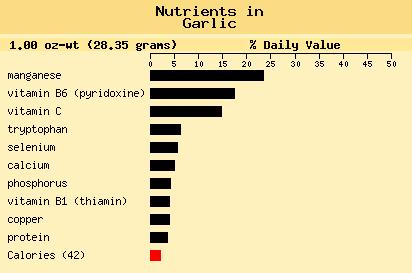
So what makes it so special? Well, let me tell you. Garlic is nature's most potent antibiotic, being part of the allium family due to its many sulfur containing compounds which give it so many of its health benefits. It combats viruses, bacteria, and intestinal parasites. It also lowers blood pressure, blood cholesterol, discourages blood clotting, contains multiple anti-cancer compounds, antioxidants, is a great decongestant, expectorant, anti-inflammatory agent, and the best immune booster/cold medication on the market. According to studies, two to three cloves a day cut the odds of subsequent heart attacks by 50% in heart patients (Ed Bauman, Ph.D.). Check out this chart from whfoods on some of the major vitamins/minerals/nutrients found in garlic:


Wow! Thats a lot of good stuff, people. These nutrients along with other compounds are what make garlic such a powerful anti-viral, anti-bacterial agent, as well as its ability to combat cardiovascular disease, yeast/fungal infections, ulcers, cancer, and more.

So...whats the best way to eat it, now that we're ALL about to rush to the nearest (organic) grocery store? Well, garlic is undoubtedly most potent in its raw form. As with any food, heat kills some important nutrients (vitamins, in particular, minerals can withstand heat), and so you are losing some of its benefits. Try 1-3 cloves/day, chopped/crushed over salads or other foods. If you can't handle it raw, add chopped/crushed garlic to foods as you are cooking, but try adding it at the end to preserve as many of its healing compounds as possible. When eating it raw, the best way to preserve these same compounds is to crush it and let it sit for about 10 minutes before eating.


Well, there it is, why I am addicted to garlic. Not a bad addiction to have. Eat up!!!